
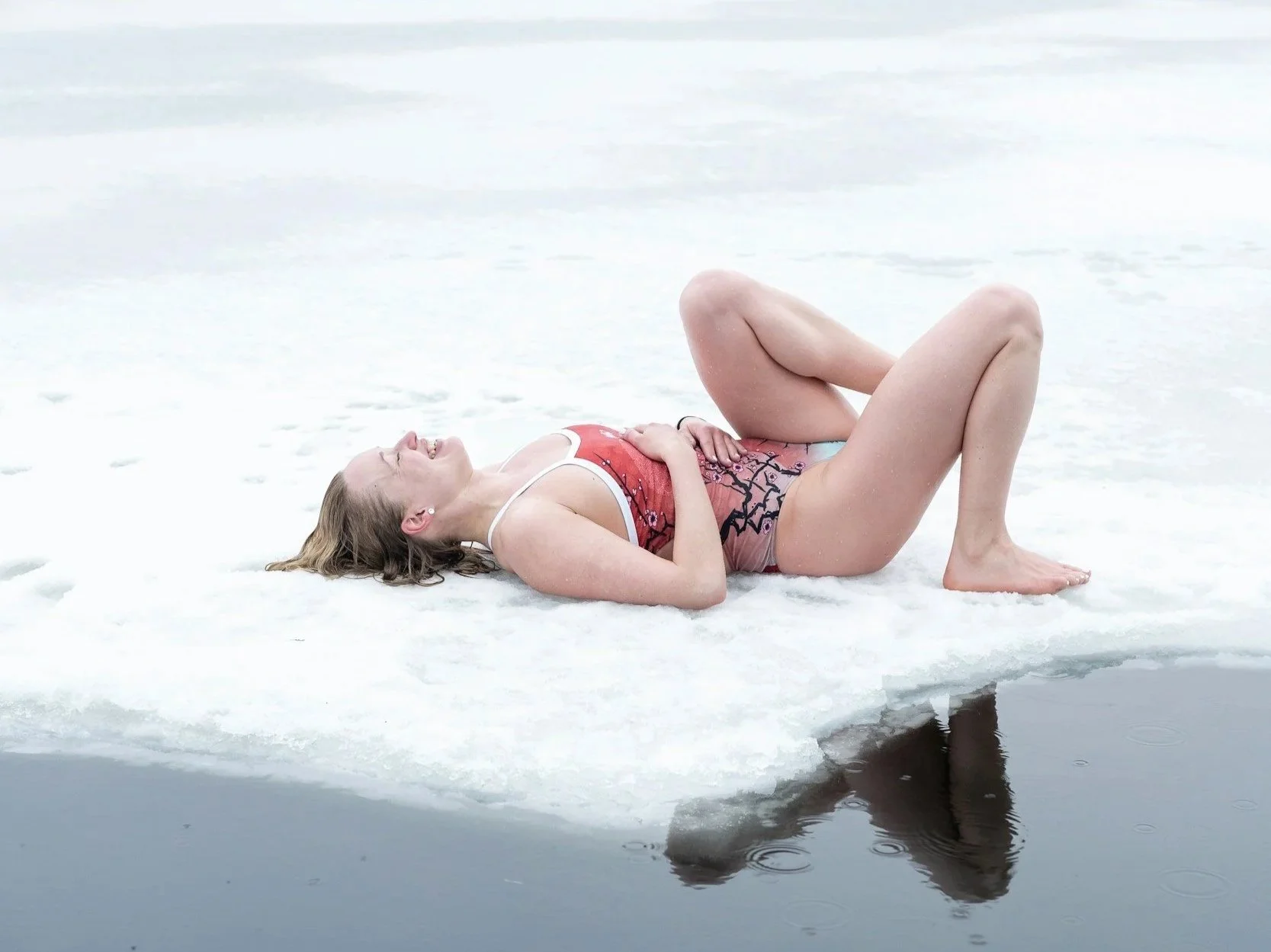
Again and again, in my workshops and conversations, I get asked: "Helena, is ice bathing even suitable for women? I've heard it messes with our hormones." That question deserves a more thoughtful answer than a flat yes or no.
Here's the fact: men and women respond differently to cold. A controlled study by Tsoutsoubi and colleagues (2022, Biology) measured this directly: under the same cold load, women showed higher cardiovascular strain and more frequent cold-induced vasodilation than men. In other words, the female body handles cold stress differently, not worse. That doesn't mean women should stay out of cold water — it means we should match cold exposure to our physiology and our cycle, instead of copying a protocol that was originally researched on men.
What the Research Actually Shows
2024 brought the largest study on this topic to date, led by a team around Megan Pound and Joyce Harper at the UCL Institute for Women's Health, published in Post Reproductive Health. Over 1,100 women took part in the survey, a large share of them in perimenopause or already postmenopausal.
Women reported that cold water swimming reduced their menstrual symptoms, especially psychological ones like anxiety, mood swings, and irritability. The effect was even more pronounced in perimenopause: significant improvements in anxiety, mood swings, low mood, and hot flushes. And it wasn't a coincidence — most women with symptoms swam specifically to ease them: over half during menstruation, almost two-thirds in perimenopause.
One important safety note from the study: participants didn't systematically record water temperature, and a 15-minute immersion at 5°C can already lead to hypothermia. That's exactly what I pass on in my own workshops too: shorter, relaxed and joyful beats long and tense. See also "How Long and How Often Should You Ice Bathe?" and "Cold bathing is easy - rewarming is the art."
Ice bathing may not replace medical treatment in your case. It can, however, be a valuable, complementary tool — especially in a life stage where many women feel left on their own by conventional medicine. If you understand German, you might want to check out Mein Neues Altes ich, a great movie about the mystery of menopause.
The Cortisol Myth
Another line I hear a lot: "They say women are more sensitive to cortisol, so they shouldn't ice bathe." That's not quite right.
Yes, ice bathing raises cortisol — that's normal, part of the stress response, and only temporary. Cortisol isn't the enemy here; it's an essential stress hormone. It helps us wake up in the morning, keeps our energy levels stable, and has anti-inflammatory effects. It rises whenever the body is under load, whether that's from stress, exercise, or ice bathing. What actually matters with any stress hormone is how long it stays elevated: short spikes can strengthen our system, while chronically high levels wear it down.
During ice bathing, cortisol spikes briefly — and right after, the body shifts into the parasympathetic state, into rest and recovery. That shift is exactly what makes it valuable for regulating the nervous system; at its core, it's training for stress resilience. How quickly that shift happens depends a lot on your ice bathing experience. It also matters that we're learning to control our breathing under stress. And over time, all of this can help us stay calmer even in everyday chaos, thanks to cold training.
So the real question isn't "woman or man," but: what state is this person in right now? Anyone who's already deeply exhausted — burnout, for example — shouldn't be adding more stress to their system, regardless of gender. What's needed first is rest. Once the body starts coming out of acute exhaustion, ice bathing can be used deliberately to help regulate a dysregulated nervous system. What's generally true — and especially important in that case — is that relaxation and calm breathing before and during the ice bath are essential. In short: it's not our gender that determines whether ice bathing is a good fit, but the state of our nervous and hormonal system.
Matching Cold Exposure to Your Cycle
Our core body temperature shifts across the menstrual cycle. In the luteal phase, after ovulation, it sits slightly higher due to rising progesterone — which is why cold can feel more intense just before and at the start of menstruation. Based on conversations with TCM practitioners and my own experience, I work on the assumption that warmth supports the body more than cold during this phase. As a former Wim Hof instructor and now a cold trainer, I've inevitably been in cold water during every phase of my cycle. Sometimes with a bit less enthusiasm, but never with any negative effects. Either way, I recommend that everyone — women especially — avoid training rigidly by the calendar, and instead check in: where am I in my cycle right now, and what actually feels right today?
In perimenopause and menopause, this hormonal landscape shifts again, fundamentally — and this is exactly where women in the study reported the strongest improvements. That matches what I experience myself and hear from many participants in my retreats: cold gives us back a tool we can actively use on our own body, in a life stage that can otherwise feel like a loss of control.
There's also a concrete connection at the metabolic level. A study on ovarian function and brown adipose tissue found that, under cold exposure, the metabolic activity of brown fat was significantly higher in premenopausal women than in postmenopausal women. The researchers link this to declining estrogen levels and suggest that this decline contributes to the general slowdown in energy expenditure after menopause — one reason why many women gain weight more easily during this stage. More active brown fat doesn't just support weight regulation; it can also reduce inflammation and improve insulin sensitivity. This is where cold comes in: Susanna Søberg and her team showed in 2021 (Cell Reports Medicine), in winter swimmers, that regular cold exposure can train exactly this tissue — they observed a stronger increase in cold-induced thermogenesis and in skin temperature over brown fat in winter swimmers compared to control subjects. That study was done in men, but the underlying principle is likely transferable: regular ice bathing may help keep brown fat active, precisely when the body is using it less on its own due to declining estrogen.
What About Pregnancy and Breastfeeding?
Let me be honest here: my own ice bathing journey started after my pregnancies, and I'm not aware of any scientific studies on this. That's not really surprising — the topic carries real risk, and the group of people affected may simply be too small to attract research funding. In 2025, a research team around Jill Shawe and Joyce Harper (the same group behind the larger study above) took on exactly this gap systematically (Lifestyle Medicine), drawing on experts in obstetrics, midwifery, neonatology, and cold physiology. Their conclusion: more research is needed before we can make reliable statements about whether intense cold exposure is safe during pregnancy. So science is still at an early stage here too. What I can offer, then, comes mainly from experience — reports from others and my own knowledge as a longtime ice bathing guide:
Some women continue ice bathing throughout their entire pregnancy, report positive effects, and go on to have healthy babies. One well-known example is Isabelle Hof, daughter of "the Iceman" Wim Hof, who speaks openly about how cold accompanied her through her pregnancies.
That said, I wouldn't recommend that a pregnant woman who's never been in cold water before start now, of all times. A cold shower can be a solid alternative instead — the same goes for breastfeeding. If, for whatever reason, you still feel the pull to start actual ice bathing during this phase, lower the water temperature only gradually to keep the stress response mild, and limit your time in the water to one or two minutes. That's the window in which core body temperature drops by only about 0.5°C — and can therefore normalize again fairly quickly.
My Takeaway
Ice bathing is absolutely not off-limits for women — but it's also not one-size-fits-all. It's worth tuning in: to your own cycle, your energy levels, to what your nervous system genuinely needs right now. If you're deeply exhausted, rest comes first. If you're pregnant or breastfeeding, go gently. And generally speaking, it doesn't always have to be a full ice bath — a cold shower or even holding your hands in cold water can already have a positive effect. But if you're ready and experienced, cold can become a powerful tool for regulating mood, energy, and your nervous system — through every phase of your cycle, through pregnancy and breastfeeding, and well beyond menopause.
Curious to experience this yourself? I invite you to browse my cold plunge offerings . There, in a safe and guided setting, you can build your own ice bathing experience and learn more about the connections and benefits of breathwork and cold training — whether you're stepping into cold water for the very first time or looking to deepen your practice.
SOURCES
Pound M, Massey H, Roseneil S, Williamson R, Harper CM, Tipton M, Shawe J, Felton M, Harper JC. "How do women feel cold water swimming affects their menstrual and perimenopausal symptoms?" Post Reprod Health. 2024 Mar;30(1):11-27.
Tsoutsoubi L, Ioannou LG, Mantzios K, Ziaka S, Nybo L, Flouris AD. "Cardiovascular Stress and Characteristics of Cold-Induced Vasodilation in Women and Men during Cold-Water Immersion: A Randomized Control Study." Biology (Basel). 2022 Jul 13;11(7):1054.
Søberg S, Löfgren J, Philipsen FE, et al. "Altered brown fat thermoregulation and enhanced cold-induced thermogenesis in young, healthy, winter-swimming men." Cell Rep Med. 2021 Oct 11;2(10):100408.
Shawe J, Felton M, Harper JC, Harper CM, Stidson R, Tipton M, et al. "Cold Water Swimming and Pregnancy: A Scoping Review and Consensus Recommendations." Lifestyle Medicine. 2025;6(1):e70009.
Blondin, D. P. et al. (2024): "Brown adipose tissue metabolism in women is dependent on ovarian status", American Journal of Physiology – Endocrinology and Metabolism.